Stage-dependent effects of systemic ASBT inhibition in a cholestasis-induced cholemic nephropathy mouse model
Abstract
Background & Aims: Cholemic nephropathy (CN) is a severe complication of liver diseases associated with cholestasis and represents an unmet medical need. Recently, we identified the molecular mechanism of CN and showed that the systemic apical sodium-dependent bile acid transporter inhibitor (ASBTi) AS0369 prevented CN in mice. However, it is not clear if ASBTi is effective in a therapeutic rather than a preventive setting.
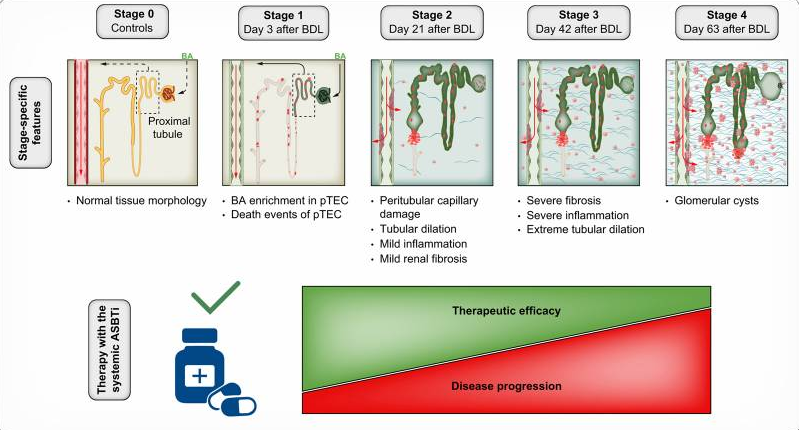
Methods: AS0369 was administered daily for 4 weeks to bile duct-ligated (BDL) mice at four CN stages: (1) early stage with proximal tubular epithelial cell (pTEC) death (BDL-day 3); (2) inflammation, leaky peritubular capillaries, and tubular dilatation (BDL-day 21); (3) fibrosis (BDL-day 42); and (4) advanced stage with glomerular cysts (BDL-day 63). Disease progression was evaluated by biochemical, histopathological, and RNA-sequencing analysis.
Results: ASBTi increased urinary excretion of bile acids (BAs) and reciprocally reduced BA concentrations in blood and renal tissue at all disease stages. Therapeutic efficacy was highest when ASBTi was given at early disease stages, e.g. urinary BA excretion was increased 9-fold (p <0.001) at the early stage compared to 4-fold (p = 0.021) at the late stage. ASBTi reduced the pTEC injury biomarker KIM-1, tissue damage, replacement proliferation, peritubular capillary damage and renal fibrosis. Additionally, late-stage disease features, such as glomerular cysts, were ameliorated (46% at the late stage, p = 0.005) by the ASBTi. RNA-sequencing revealed that ASBTi attenuated BDL-induced gene deregulation at all stages, with a larger effect size at early stages.
Conclusions: Early systemic ASBTi therapy, initiated at the onset of pTEC death, provides the greatest therapeutic benefit. Nonetheless, even at later stages, ASBTi can ameliorate features of advanced CN.
Impact and implications: This study demonstrates that systemic inhibition of the apical sodium-dependent bile acid transporter (ASBTi) alleviates cholemic nephropathy across disease stages in a bile duct ligation mouse model. The greatest benefit was achieved when treatment was initiated early, coinciding with proximal tubular epithelial cell death, but even advanced features such as glomerular cysts were partially reversed. These findings highlight ASBTi as a promising therapeutic strategy for cholemic nephropathy, addressing a major unmet need in cholestatic liver disease. By targeting bile acid accumulation and related injury pathways, ASBTi may improve renal outcomes and broaden treatment options in affected patients.
Keywords: cholestasis, acute kidney injury, bile duct ligation, entero-nephro-hepatic circulation, bile cast